Friends of 5 and 10
The complement techniques at the base of the soroban — where the real method begins.
A real Japanese soroban, played as a game, 10 minutes a day. By the book, with no drilling — your child genuinely calculates in their head instead of tapping buttons.
Runs in the browser or installs as an app — offline, on phone and desktop. Progress is saved.
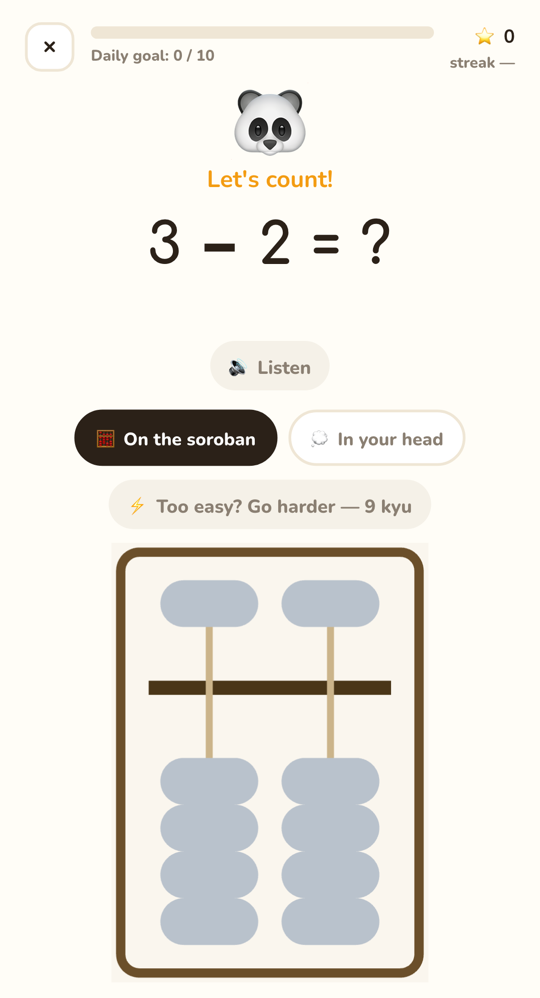
We take you by the hand from the very first screen and show you where to start. Nothing to figure out.
Learn to picture a number on the abacus and master the “friends of 5 and 10” — the soroban foundation.
A short session with a daily goal. Streaks and stars keep the rhythm without any pressure.
We take the abacus away step by step — what stays is the mental image. That is anzan.
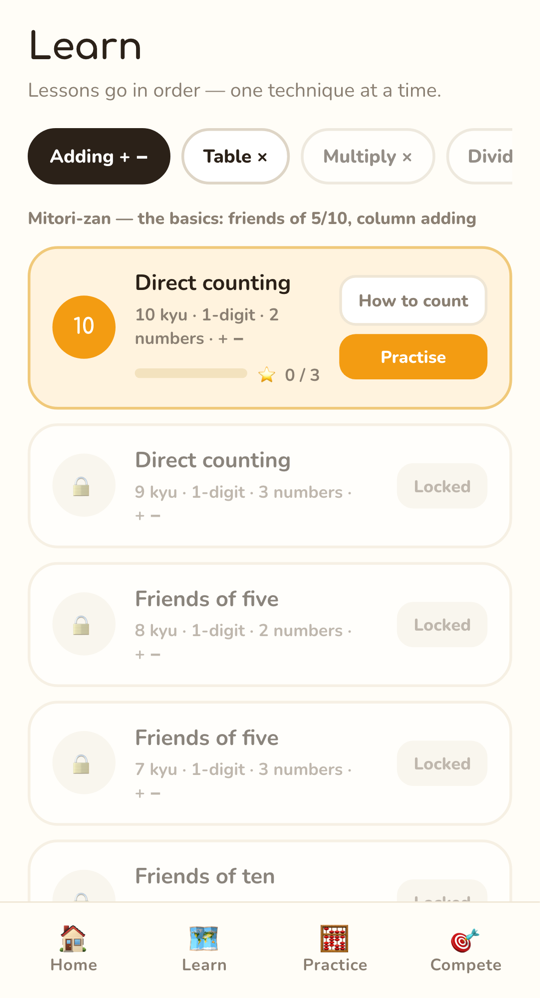
Lessons come in order: the next one unlocks once the previous is solid. Your child always knows what to do next.
We don't promise “genius” or “superhuman memory”. We teach the classical Japanese method — honestly and by the book.
The complement techniques at the base of the soroban — where the real method begins.
Your child sees the number on the abacus instead of memorising answers. That's where mental math comes from.
The Japanese ladder of ranks: from 10 kyu to 1 kyu and beyond. A clear route to mastery.
A new technique is practised with the hands first — the answer is set with the beads. Only then comes “in your head”. That's how it's taught by the book, rather than guessing at the answer.
This isn't a fashionable “early development technique” but a school of calculation proven over centuries — and still alive in Japan today.
The soroban's ancestor — the Chinese suanpan — reaches Japan with merchants.
The Japanese simplify the abacus: one “heaven” bead is worth 5, four “earth” beads are worth 1 each. Counting got faster.
The soroban is still on the curriculum, and kyu and dan ranks are sat as official exams.
Masters move the beads mentally and add three-digit numbers faster than a calculator.
Want the longer story, with beads you can actually move? It's right there in the app — together with the interactive soroban.
Game mechanics keep the rhythm — without pressure or “screen time for its own sake”.
A chain of days in a row. Missed one? A streak freeze has your back.
A reward for accuracy and speed — not for time spent in the app.
The path and the next goal are visible — just like in the games they love.
Everyone gets the same tasks — a fair contest. 🏆 The daily board resets every day: there's always a chance.
We'll nudge you about practice so the streak doesn't burn — even when the app is closed.
Too easy? The “Make it harder” button raises the level. And you can set your own daily goal — anywhere from 1 to 1000 problems.
The parent dashboard shows practice time, accuracy and the current level for each child. One account — several child profiles, each with its own progress.
No need to type your password on a child's device. Open the parent dashboard, show the code or the QR — your child enters it on their tablet, and the profile links to your account.
Same engine, grown-up theme. Numbers flash by and you add them in your head — a workout for focus and speed. Beating a calculator is genuinely within reach. And on the 🏆 daily board you can beat everyone else.
Try flash anzanFrom age 6 — that's the kids' theme. Teens and adults get their own theme and flash anzan.
About 10 minutes a day. Consistency matters more than length — that's what streaks are for.
Yes. Practice works offline, and progress syncs as soon as you're back online.
Yes — the daily challenge leaderboard: everyone gets the same tasks, the board resets every day, and accuracy counts for more than speed. The board shows only a profile name and an emoji avatar — no last names, no email, no personal data.
In the parent dashboard, tap “Connect a device” — you'll get a code and a QR. Your child enters the code (or scans the QR) on their own tablet, and their profile links to your account. No password is typed on the child's device, and progress shows up in your dashboard right away. You can disconnect a device at any time.
We're in early access — everything is completely free. A subscription will appear inside the app later, along with a referral bonus program. Progress you've earned stays yours, and we'll announce the subscription well in advance.
Not necessarily — it opens right in the browser. But you can install it as an app on your phone or computer in one tap: you'll get an icon on your home screen and it will work offline, like any app from a store.
10 minutes a day — and in a couple of months mental math becomes a habit. We're in early access right now: everything is free.
Start free